
This tutorial explains, step by step, how to create and configure item-control surveys in GlobalSuite®, based on the item methodology.
This guide details the phases corresponding to the survey model and the configuration of item-control surveys, including the selection of the item control methodology, the definition of visible, editable, or mandatory dimensions, and the possibility of attaching reference documentation for those responsible. It also describes how to associate items and controls from the inventory to the risk analysis, and how to save the final configuration for later publication.
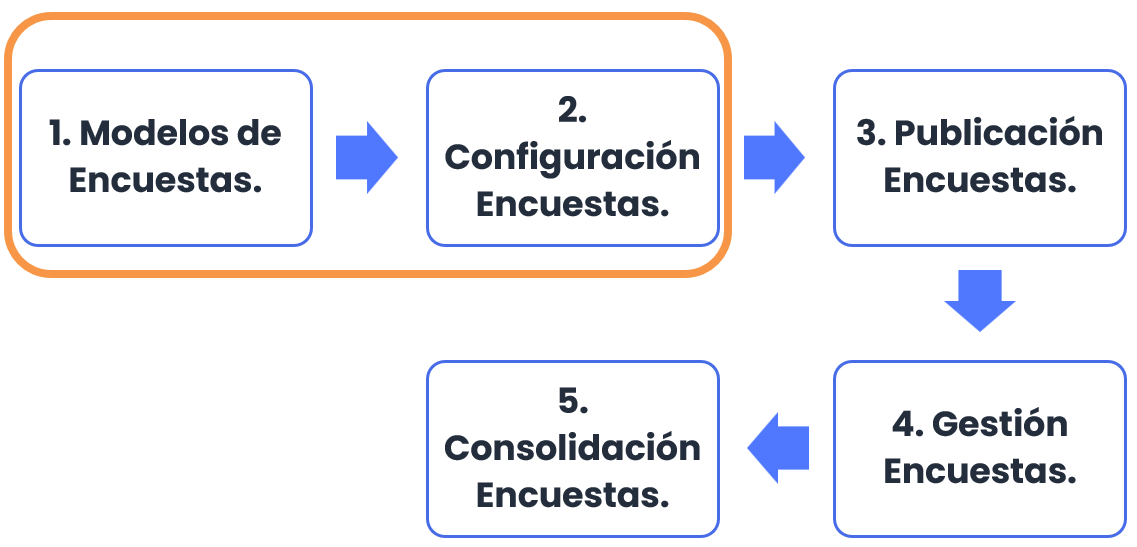
Phases for Conducting Item-Control Surveys
This guide will explain phases 1 and 2 of the survey creation process
Survey Models
GlobalSuite® allows identifying and classifying the inventory of items, performing risk analysis, and evaluating the organization's controls through surveys sent to various responsible parties within the organization. To do this, the survey template to be sent must first be created. Multiple templates can be created and configured to adapt them to the organization's needs.

For this purpose, each survey template can be configured by indicating its type. There are three types of surveys that can be considered when creating a template:
-
Item Survey: Allows the identification of items, their categorization, and classification.
-
Risk Survey: Allows the identification of risks for each item (including services and processes) as well as their evaluation according to the organization's methodology.
-
Control Survey: Allows the identification of controls implemented in the organization as well as their maturity evaluation according to the corresponding methodology.
This guide will explain the functionality of the type “Item-Control Survey” (Item Methodology).
To configure a survey model, you must be an Administrator user (Platform Administrator, Enterprise Administrator, or Configuration Administrator), as it is located in the Settings> Survey Models section.
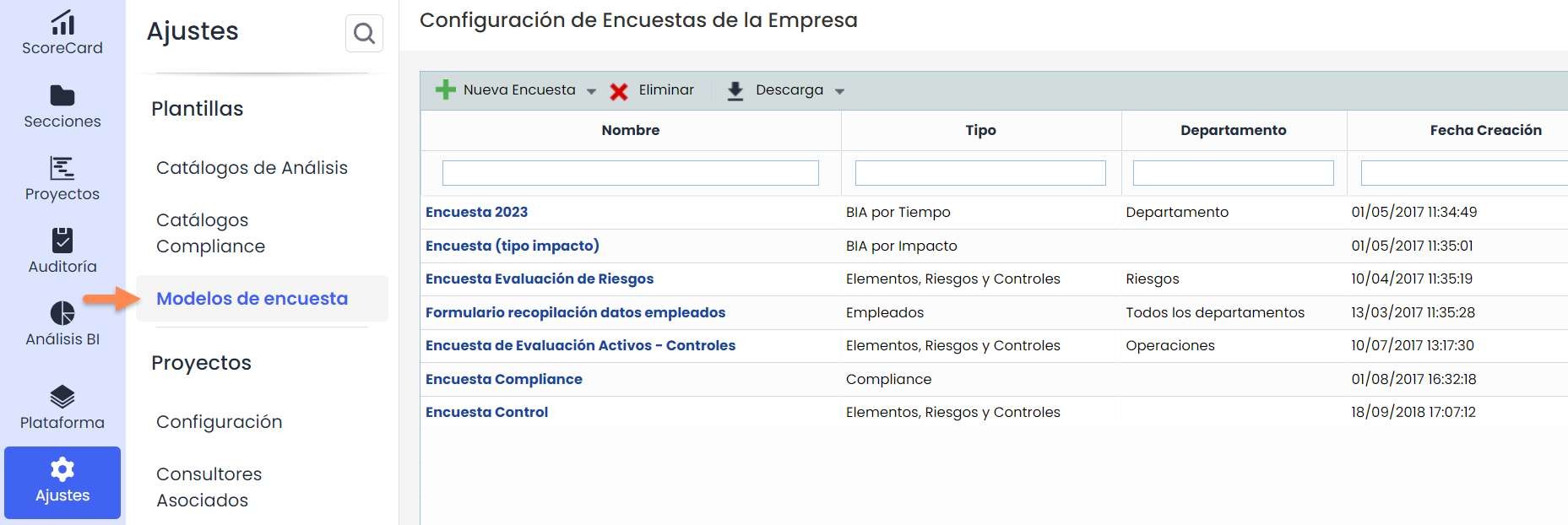
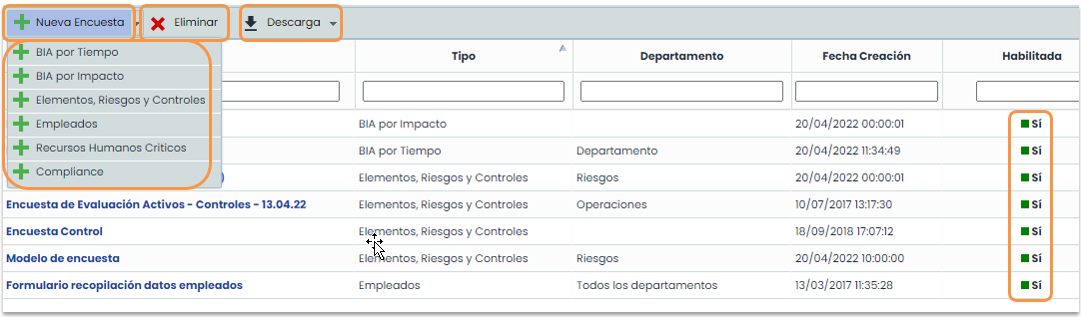
In this option, you must choose the type of survey model you want to create using the “ New Survey” button (in this case, the type “Items, Risks, and Controls”). Additionally, in this option, you can delete models (button “ Delete”) and download a list of the configured models (button “ Download”).
The last column will show the templates that are enabled. Surveys can only be created from enabled templates.
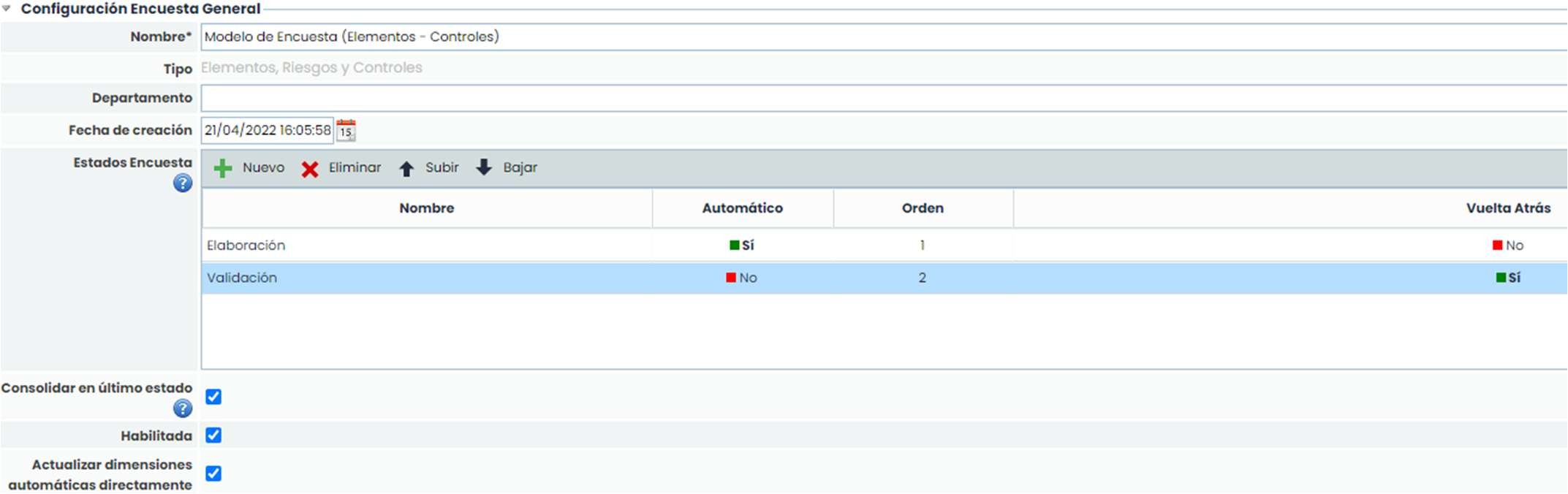
Within the survey model, you can configure aspects such as the name, department, or creation date, as well as indicate whether the model should be enabled for use and whether you want to “Consolidate in the last state,” meaning that from the last state of the workflow, the survey data can be directly consolidated into the final analysis.
It is also possible to use states in the survey. Using these states allows different people to fill in or validate information entered in previous states. You can move from one state to another automatically by marking the indicator (automatic check) and also move back to a previous state in the same way, by marking the corresponding indicator (rollback check).
In the “Survey Type” section, you must choose the type of model you want to create. In this case, the type “Item-Control Survey (Item Methodologies)” will be selected.
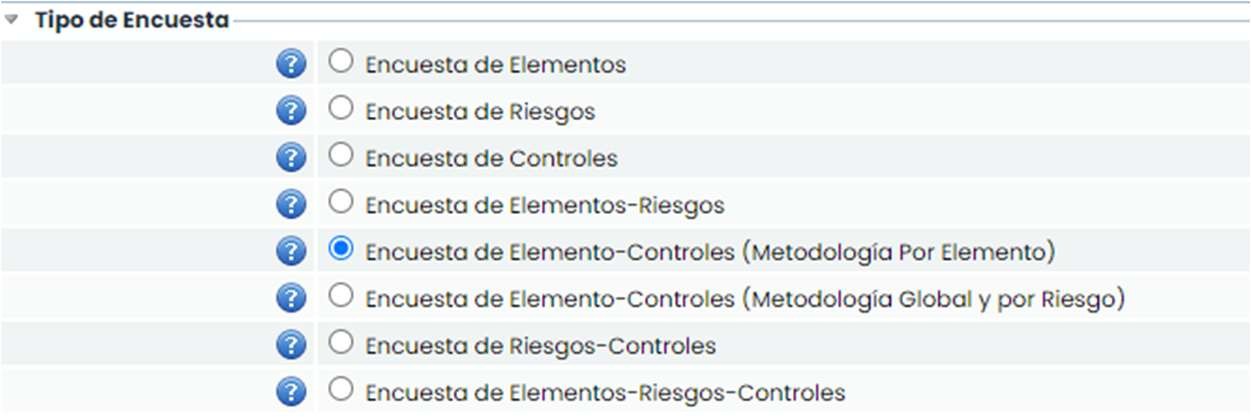
Next, three sections are displayed that allow for configuration.
First, the “Additional Configuration” section is shown, where you can choose which options you want to include in the survey.

By default, implemented controls are marked so that this type of controls is displayed in the survey.
To unmark this type of control, another type must be marked; therefore, it can only be unmarked when the option for treatment plans is also marked, which are controls that are under study and improvement and have not yet been implemented.
When treatment plans are marked, actions are also marked by default; it is not possible to mark treatment plans without actions.

Actions can also be included for implemented controls and evidence in the survey for both implemented controls and treatment plans.
In this way, when completing the survey and evaluating a control, or creating a new one, the actions of that control can be indicated, and its evidence can be attached.
In the next section “ Item Survey,” the dimensions configured in the item inventory are displayed, indicating the type of dimension and whether it is manual or automatic.

The user can configure the following options for each dimension:
-
Visible: allows defining whether the dimension will be included in the survey or not by clicking on the cell.
-
Editable: indicates whether the dimension can be modified in the survey or will only be visible in consultation mode.
-
Mandatory: indicates the requirement to fill in a dimension when transitioning states, in case surveys with states are used.
-
Question: in the case of “Form” type surveys (explained later), allows displaying an explanatory question instead of just the dimension name.
If a dimension is selected, it is possible to change the order in which it will appear. Using the “Move Up” and “Move Down” buttons, it can be positioned in the desired place.

With the “ Update Dimensions” button, as indicated by the yellow message, the list of dimensions of the item methodology is updated in case new dimensions have been added after the model creation.
The settings for the previously existing dimensions are preserved; only the new dimensions created in the item methodology appear to be included in the survey.
When selecting a dimension, in the lower table (“Item Levels”), the levels configured in Settings > Item Methodology . are displayed for informational purposes.

In the third section, “ Control Survey,” you must select which control methodology you want to use in the survey. It should be noted that only methodologies that have defined the type of control evaluation by item will appear.

When selecting the methodology, the dimensions configured in it are displayed. The user can configure the options just like with the item dimensions.

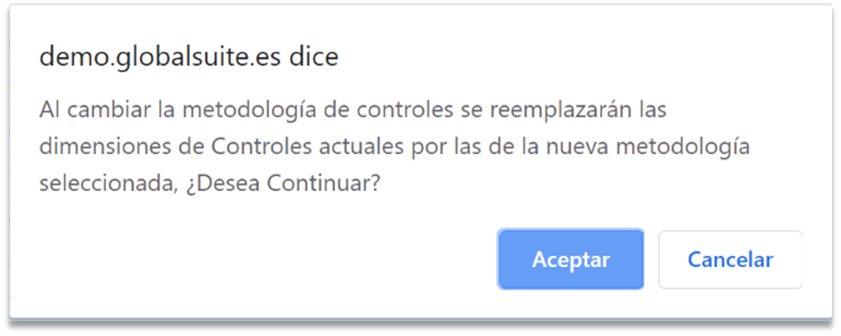
When choosing the methodology, an informational message is displayed indicating that the dimensions will be changed to those of the selected methodology.
If a dimension is selected, it is possible to change the order in which it will appear. Using the “Move Up” and “Move Down” buttons, it can be positioned in the desired place.

With the “ Update Dimensions” button, as indicated by the yellow message, the list of dimensions of the control methodology is updated in case new dimensions have been added after the model creation.
The settings for the previous dimensions that already existed are preserved; only the new dimensions created in the control methodology appear to be included in the survey.
In the “Attachments” section, you can attach the necessary files to the survey so that the recipient can consult them.
The available options are:
-
Select file: allows you to search and select a file from your file explorer.
-
Attach: allows you to upload the selected file.
-
Delete: allows you to delete a selected file in the “Associated Documentation” table.
-
Download: allows you to download the selected file in the “Associated Documentation” table.
-
View: allows you to view the selected file in the “Associated Documentation” table from the browser. Only files with the extensions .pdf, .jpeg, .jpg, .bmp, or .png can be viewed.

Survey Configuration
Once the survey model is configured, it can be used to configure as many surveys as required. To do this, go to the option located in Management> Surveys
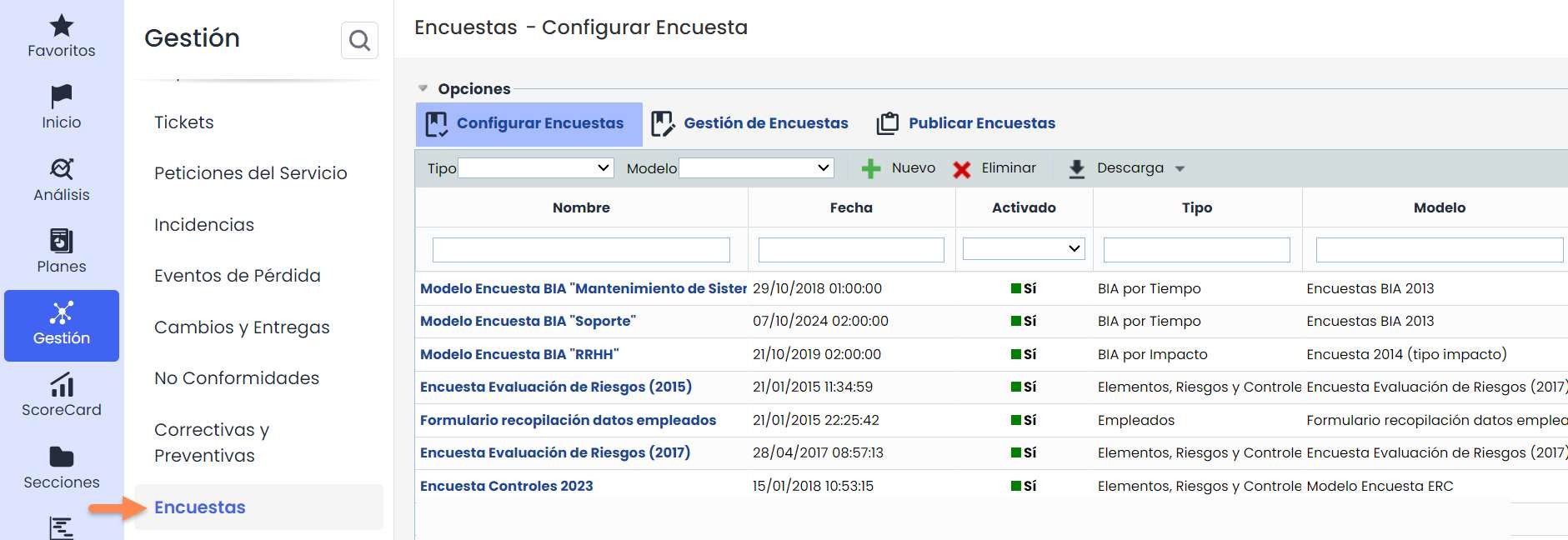
To create a survey configuration, you must filter by the survey type and then choose the desired template.
By clicking the “ New” button, a survey of the chosen type and model will be created. If you want to delete the configuration of a survey, you must click the “ Delete” button. Keep in mind that if a Configuration is deleted, all surveys created from this Configuration will also be deleted.
It is also possible to download the list of survey configurations in both Excel and PDF formats.

When accessing the survey configuration, a set of sections appears that allow its configuration.
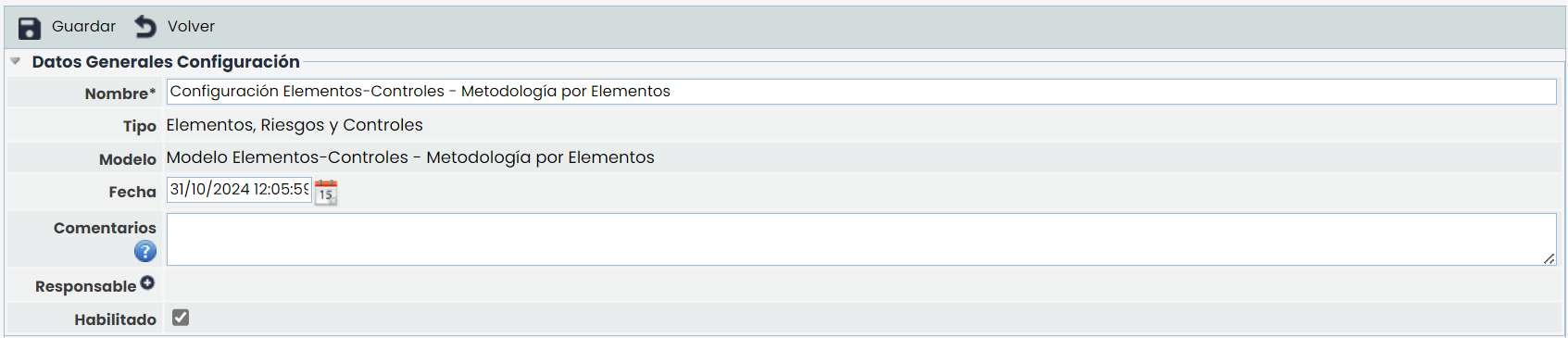
In the first section, “General Configuration Data,” you can identify the configuration name, view the type and model of the survey, change the date, and also activate or deactivate the “ Enabled” check, which allows indicating whether the Configuration can be used to generate new surveys.
If states (workflow) have been included in the modeling, then the configuration also includes the “States” section to assign a responsible person to each state.

In the “ Risk Configuration” section, information related to Items and Controls appears. You must select the risk analysis with which you want to conduct the survey, and once chosen, you can include the items from that analysis using the “ Add Items” button, as well as delete them with the “ Delete Items” button.

Once the analysis is chosen, you must indicate which items will be included in the survey. To do this, you must add them through the “ Add Items” button, and they can also be deleted with the “ Delete Items” button.
By clicking the “ Add Items” button, a pop-up window opens with all the items that are part of the item inventory. Filters can be used, either by the item name or by category, as shown in the following image:
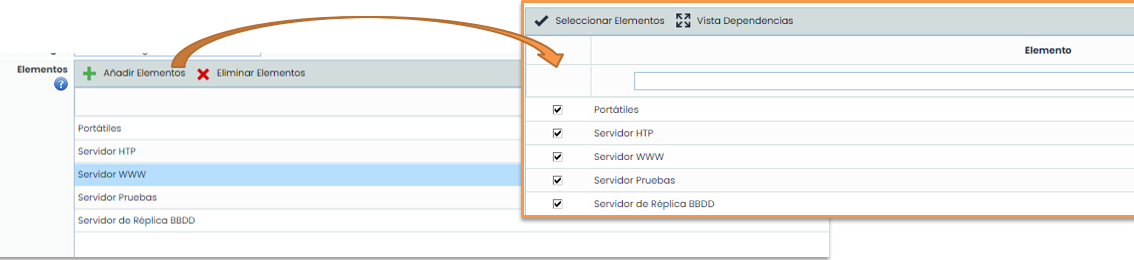
To select the items to include, you must check the box next to each item on the left side, and once selected, press the “Select Items” button.
With the “ Dependency View” button, the items are displayed in the item tree so that their relationships can be seen.
Once the items are selected, in the lower table “Controls,” the item-control relationship can be seen, and through the check on the left, you can choose which controls you want to include in the survey.
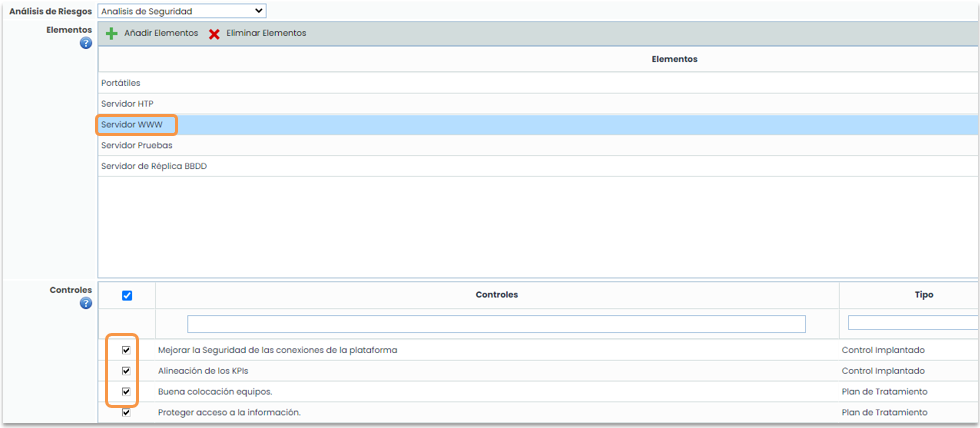
Once the configuration data is completed, press “Save,” and it will be ready for use.
From the “ Attachments” section, you can add specific documents to the configuration itself. Additionally, you can view and/or manage the documents inherited from the survey model.
