
Ticket Data
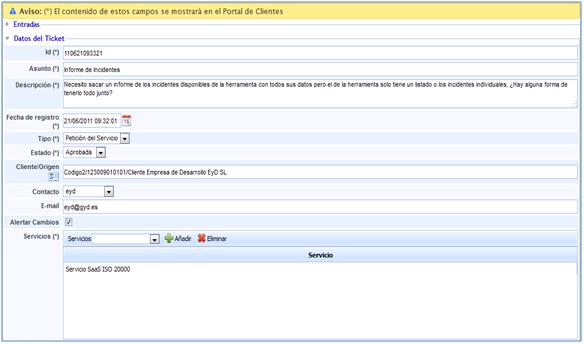
To access any service request, simply click on the ID or subject in the request list on the main screen. Once inside, GlobalSuite provides us with the following options:
-
Id: Corresponds to the name or identifier of the generated service request.
-
Subject: This field defines the title of the service request.
-
Description: This is one of the most important points, as it is through this field that the service request is specified in as much detail as possible.
-
Registration Date: Communication date.
-
Type: It is fixed as it is a service request.
-
Status: Defines whether the service request is registered, approved, denied, or closed.
-
Services: This field will associate the services linked to the request.
All the fields identified above are the ones that will appear in the information received by the client if the service request has been communicated through the Client Portal.
GlobalSuite also allows defining the following information in service requests:
-
Client/Source: If it has been opened from the portal, this field will be automatically completed. If it is opened manually, the solution allows you to set the source.
-
Contact: If it has been generated from the client portal, the contact will correspond to the person responsible for generating the event. This contact field is editable, allowing you to specify another user to be informed about the status of the request.
If it has been generated manually, this field will indicate who should be contacted to inform about the status of the event.
-
E-mail: Indicates the email to which the status of the request can be communicated.
-
Alert changes: By selecting this option, GlobalSuite will send information about status changes and classifications made to the request to the email indicated in the field above.
-
NOTE: If a mailing group has been generated in the 'Home/Business Relations' section, the tool allows sending alerts to a specific group. To do this, the desired company must be selected (it must be created in the 'Home/Business Relations' section), and it must be determined whether to alert a Contact or a Group. In the case of selecting a Group, the tool offers the possibility of choosing the group to notify about ticket changes.
.jpg?cb=b7e53c8471e403d055165a9fb1eafac2)
-
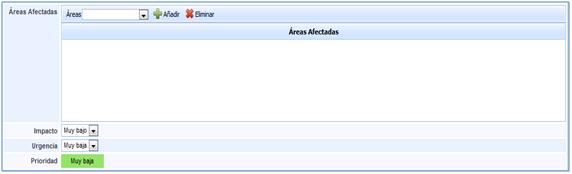
Impact: Allows setting a qualitative value to determine the level of damage caused by the service request.
-
Urgency: Allows setting a qualitative value to determine the speed with which the request should be resolved.
-
Priority: This value is automatically generated by GlobalSuite®, calculating the arithmetic mean of the values set in the impact and urgency fields.
In addition to recording information, the solution also allows you to:
Risks
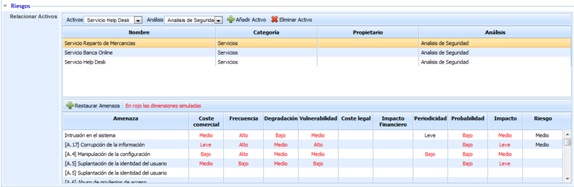
It offers the possibility to view the elements affected by the event and values defined in the risk analysis. The tasks that can be performed in this section are:
-
Elements: Allows selecting the affected item(s) by the event.
-
Analysis: Allows selecting the risk analysis where the selected item is evaluated.
NOTE: The same item can be evaluated in different risk analyses with different evaluations, hence the need to indicate the risk analysis we want to load.
-
Add Item: Once the item is selected, it allows inserting it into the table.
-
Delete Item: Allows deleting one or more items from the table. To do this, the desired row must be selected, and the 'Delete item' button must be clicked.
Once the desired item's row is selected, the table at the bottom allows the user to view or modify the values defined in the 'Analysis/Risk Analysis' section. The tool highlights in red those evaluations that have been modified.
NOTE: The tool allows simulating how the incident affects the evaluated items in the 'Risk Management/Projection and Simulation' section. Depending on the methodology defined in the 'Settings/Analysis Methodology' section, the dimension evaluations can be qualitative or quantitative.
The actions that can be performed on the table are:
-
Restore Threats: Allows restoring the initial values of the table according to the Risk Analysis performed.
Employees
-
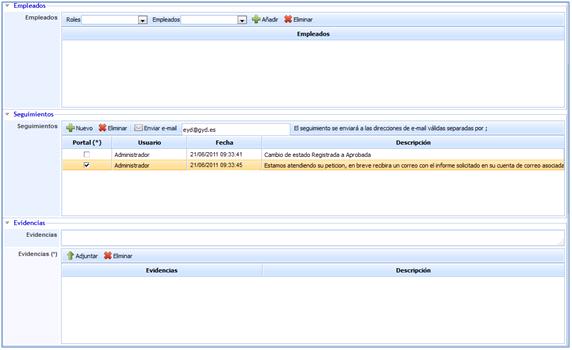
Employees: Allows defining the employees who will handle the treatment of the service request. These employees must have been defined in the employee management option.
Follow-ups
-
Follow-ups: Within this option, any modification or change made to the event in question can be identified.
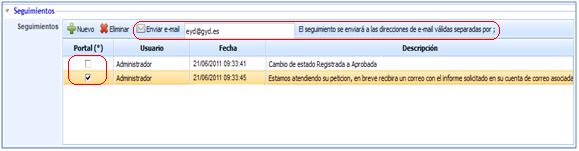
Any follow-up of the service request that is recorded can be sent via email to all those considered necessary to inform. As indicated, it is necessary to specify the email addresses and use the Send email option.
On the other hand, if it has been generated from the client portal, it will be informed through this medium by selecting the corresponding follow-up in the Portal column. Once saved, it will generate the notification automatically.
Evidence
-
Evidences: To define as completely as possible, the solution allows attaching any type of file. If such documentation is not attached, it is also possible to provide a description in the Evidences field.
Closing Data
Once the service request has been resolved, GlobalSuite® allows defining how it has been addressed.

-
Resolution: To indicate the way in which it has been addressed and which has allowed closing the service request.
-
Closing Date: Allows indicating the exact date and time when the request was closed. This formula provided by GlobalSuite allows measuring the time taken for this closure.
Inputs and Outputs
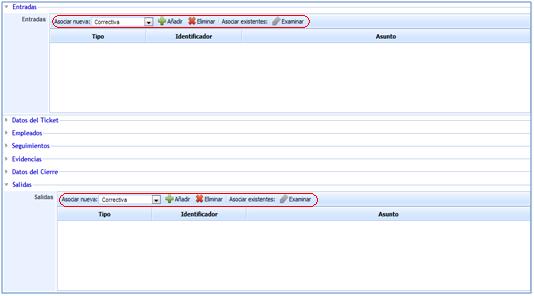
The solution considers the option that the service request originates from a different event or, conversely, that this request may generate one. For these specific cases, the following options are presented:
-
Inputs: Allows determining if the defined service request originates from another type of event, providing the tool with the following options:
-
Corrective action.
-
Preventive action.
-
Non-conformity.
-
Change.
-
Service Request.
-
Incident.
-
Problem.
-
Event.
-
False positive.
-
-
Outputs: Allows determining if the defined service request results in another type of event, providing the tool with the options previously mentioned for the input.
For both inputs and outputs, a series of common options are identified:
-
Add: By selecting the type of event from which it originates or to which it leads, it will be included in the corresponding field, generating said event in another option provided by GlobalSuite®, except in cases of Event and False Positive.
-
Delete: Deletes any event that has been added.
-
Associate Existing: If the event from which it derives has been created previously, this option allows searching for that event so that it can be associated with the corresponding service request.