
This option offers the possibility to perform compliance assessments of different catalogs, where each catalog can contain requirements of standards, laws, or regulations applicable to the organization.
The tool provides a list of catalogs previously defined in the section ‘Settings/Compliance Catalogs’ as shown in the following image:
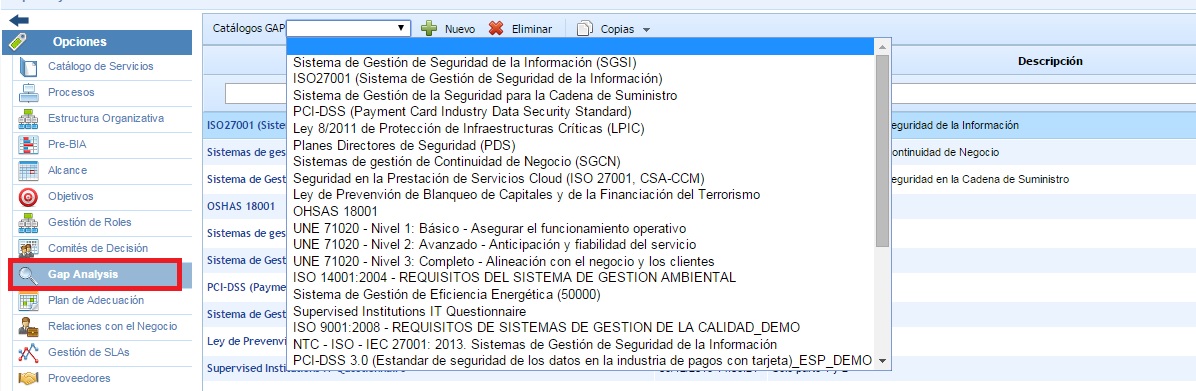
To include a catalog in the table, the desired catalog must be selected from the dropdown list and the ‘New’ button must be clicked. If you want to remove a catalog from the list, you must select the corresponding row or rows of the catalog and click the ‘Delete’ button. The ‘Download’ button allows you to download the GAP list in an editable format (.xlsx) or in .PDF format.
Similarly, it is possible to make copies of a completed GAP. To do this, you need to select the catalog you want to copy and click on the "Copies" button. This button allows you to make a copy both in the Gap Analysis option and in the "Compliance" option located in the Analysis menu.
To access a catalog and perform the GAP Analysis, you need to click on its name. Upon accessing, there are two options detailed in the following sections:
Requirements Analysis
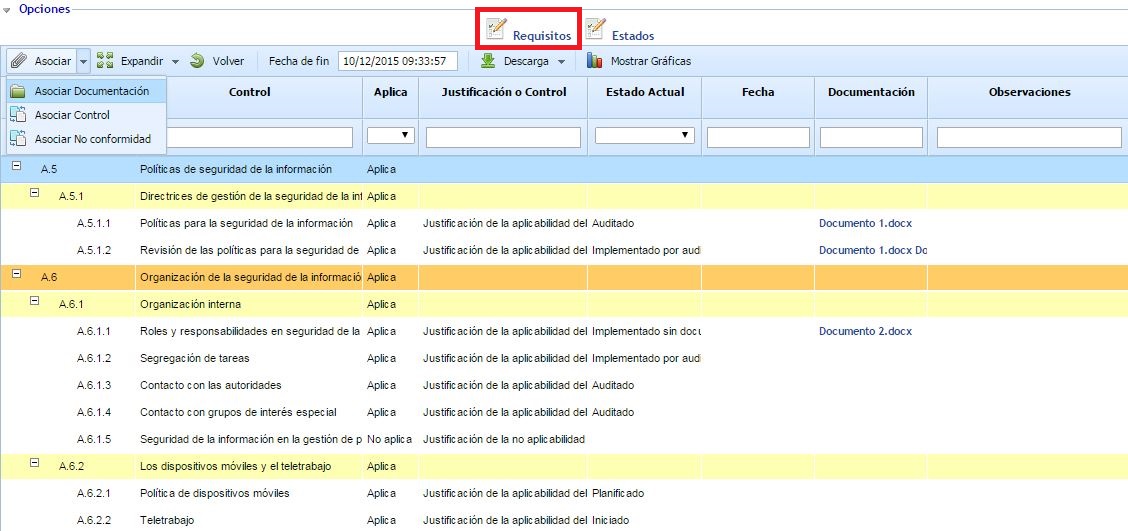
Upon accessing, the "Requirements" option is loaded by default, which contains the structure of the compliance catalog requirements. The options available for the catalog are as follows:
-
Associate - Associate Documentation: Allows associating one or more documents from the document manager to the compliance catalog requirements. To do this, you must select the desired row and click on the ‘Associate Documentation’ button, which opens the following screen:
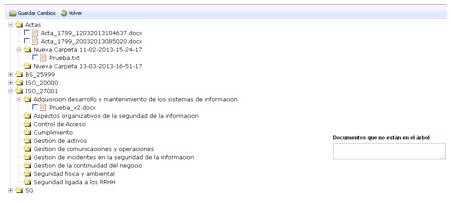
The screen shows the document tree stored in the Document Manager (Sections/Document Manager). To associate the documentation, you must select the checkbox(es) of the desired documents and click the ‘Save Changes’ button.
If the user wants to reference one or more documents not stored in the Document Manager, the tool allows identifying the documents in the box located on the right side, so they are identified in the desired control.
If you want to remove an association, the user must access the document tree, uncheck the desired checkbox(es), and click on the ‘Save Changes’ button.
-
Associate - Associate Control: Allows associating one or more controls, registered in the "Control Management" option, to the compliance catalog requirements. To do this, you must select the desired row and click on the 'Associate Control' button, which opens the following screen:
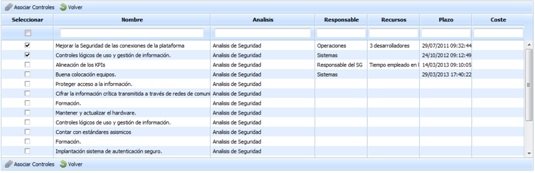
The screen shows the list of controls defined in the 'Analysis/Control Management' section. To associate one or more controls, you must select the checkbox(es) of the desired controls and click the ‘Associate Controls’ button.
If you want to remove an association, the user must access the control list, uncheck the desired checkbox(es), and click on the ‘Associate Controls’ button.
-
Associate - Associate Non-Conformity: Allows associating one or more non-conformities to the compliance catalog requirements.
-
Expand: Displays the complete structure of the compliance catalog.
-
Collapse: Collapses the structure of the compliance catalog, leaving only level 1 requirements visible.
-
Back: Allows returning to the previous screen, where the list of all compliance catalogs is located.
-
End Date: Allows indicating the end date of the catalog evaluation.
-
Download: Allows downloading the catalog, available in two formats:
-
Docx Report.
-
CSV Report.
-
Show Graphs: Displays different graphs representing the implementation status of the compliance catalog requirements.
-
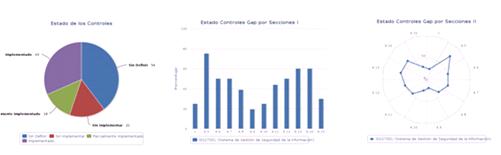
In addition to the previous options, it is possible to edit the different columns of the table containing the compliance catalog. The function of each column is as follows:
-
Applies: Allows identifying whether the requirement or control applies or does not apply within the organization. To set the value, you must double-click on the cell and select the desired option from the dropdown. The tool allows setting as "Applies" or "Does not apply" to a group of requirements or controls, so that all requirements/controls at lower levels are set with the same value.
-
Justification or Control: Allows indicating a justification for the applicability or non-applicability of the control. To do this, you must double-click on the cell, and a text box will appear where you can write.
-
Current Status: Allows indicating the implementation status of the requirement or control within the organization. Clicking on the cell will display the available options to define the status, based on the statuses configured for the compliance catalog. The tool offers a series of default statuses for the catalogs, but these statuses are configurable both in the "Compliance Catalogs" option in the 'Settings' section and in the catalog itself in the top "Statuses" option (see next section).
-
Date: Allows setting a date for the requirement or control. This date can be used, for example, to identify the date of the requirement evaluation or its implementation date (as desired).
-
Documentation: Displays the documents associated with the requirement or control, allowing the documents to be downloaded by clicking directly on the link. To associate documents to a requirement, you must select the requirement and click on the "Associate Documentation" button available at the top.
-
Observations: Allows including observations and relevant data to justify the control's status.
-
Grouped Controls: Displays the controls, from the "Control Management" option, associated with the requirement, allowing access to the control details by clicking directly on the link. To associate controls to a requirement, you must select the requirement and click on the "Associate Control" button available at the top.
Note: This column is hidden by default. To view the column, you must right-click on the table header, allowing you to add the column.
-
Non-Conformities: Displays the non-conformities associated with the requirement, allowing access to the non-conformity details by clicking directly on the link. To associate non-conformities to a requirement, you must select the requirement and click on the "Associate Non-Conformity" button available at the top.
Note: This column is hidden by default. To view the column, you must right-click on the table header, allowing you to add the column.
States Configuration
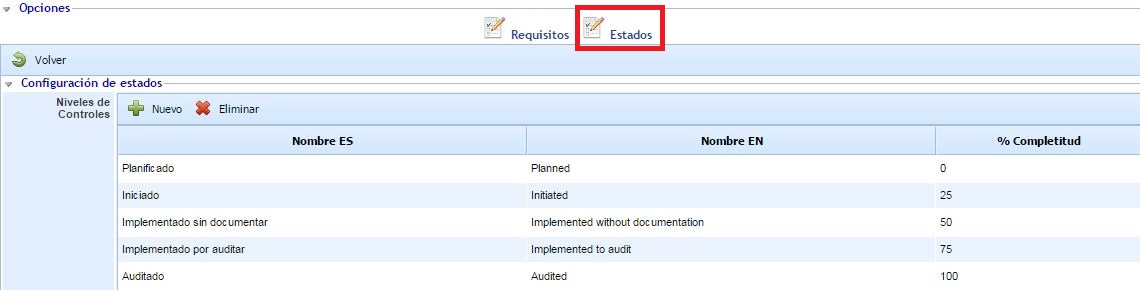
This option allows configuring the statuses to be used to analyze the compliance catalog. By default, the statuses that appear correspond to the statuses configured for the compliance catalog in the "Compliance Catalogs" option in the 'Settings' section.
The default statuses can be configured specifically for this GAP Analysis. This allows modifying the statuses only for this GAP Analysis, so that if the compliance catalog is reused in the "GAP Analysis" option or in the "Compliance" option, it will default to the statuses defined in the catalog template.
To modify the statuses, you must use the "Add" and "Delete" buttons. It is possible to edit the name of each status in both Spanish and English, so users can see the status in the language configured in their profile.
Finally, each status has a completion percentage. This percentage is used to calculate the compliance graphs of the compliance catalog, considering the percentage of each of the catalog's requirements.