
New features and improvements
Analysis - New Risk Scenarios module with Monte Carlo simulation
The new Quantitative Risk Scenarios module is introduced, a new block of GlobalSuite GRC that enables quantitative risk simulations based on Monte Carlo.
This functionality transforms the risk analyses already defined in GlobalSuite into quantified, comparable, and actionable scenarios, facilitating result analysis, loss estimation, and decision-making on mitigation measures.
Based on the risks identified in an existing analysis, the user can create simulation scenarios, configure frequency and impact variables, run thousands of iterations, and obtain a quantitative view of risk exposure.
Try the module for a limited time
During the launch period, a direct activation of a temporary demo of the Quantitative Risk Scenarios module is enabled. An easy way to discover how Monte Carlo simulation helps quantify risk exposure, compare scenarios, and support decision-making with data.
Access the demo at Analysis > Risk Scenarios
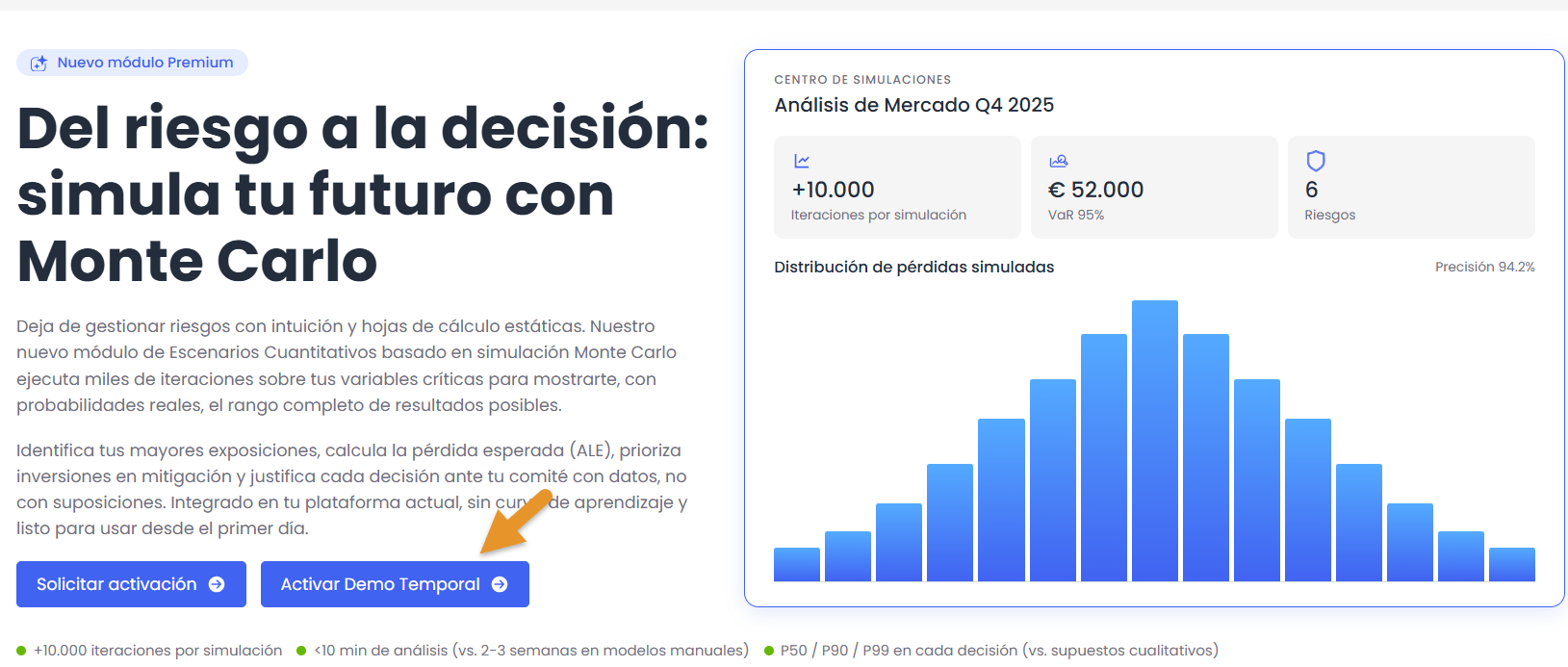
Request additional information about this new functionality by writing to hello@globalsuitesolutions.com
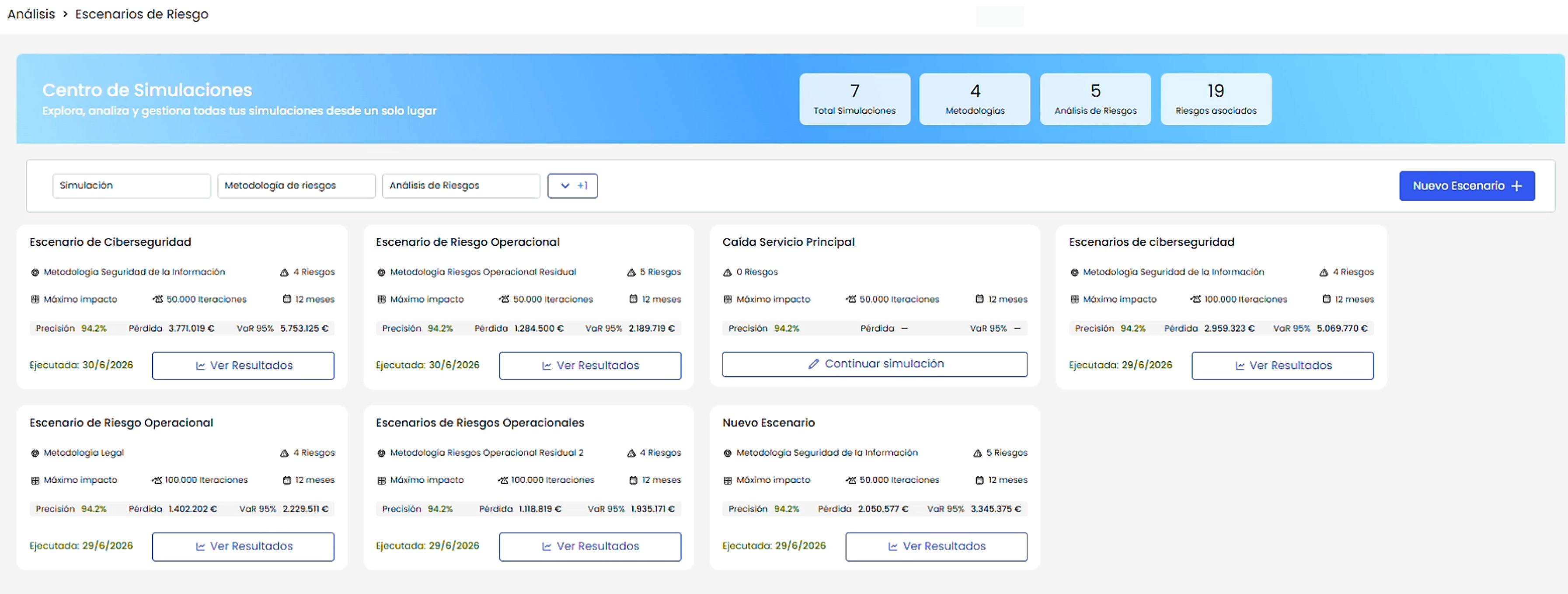
The module is available at Analysis > Risk Scenarios and includes a Simulation Center where generated scenarios can be created, reviewed, and compared.
Key features
-
New Simulation Center to review all risk scenarios from a single screen.
-
Scenario creation through a guided Monte Carlo simulation wizard.
-
Calculation of expected simulated loss based on the frequencies and impacts defined for the selected risks.
-
Summary screen prior to execution, consolidating configured parameters, simulation scope, included risks, and estimated expected loss.
-
Execution of Monte Carlo simulations with thousands of possible scenarios, considering the materialization or non-materialization of risks in each iteration.
Results and analysis
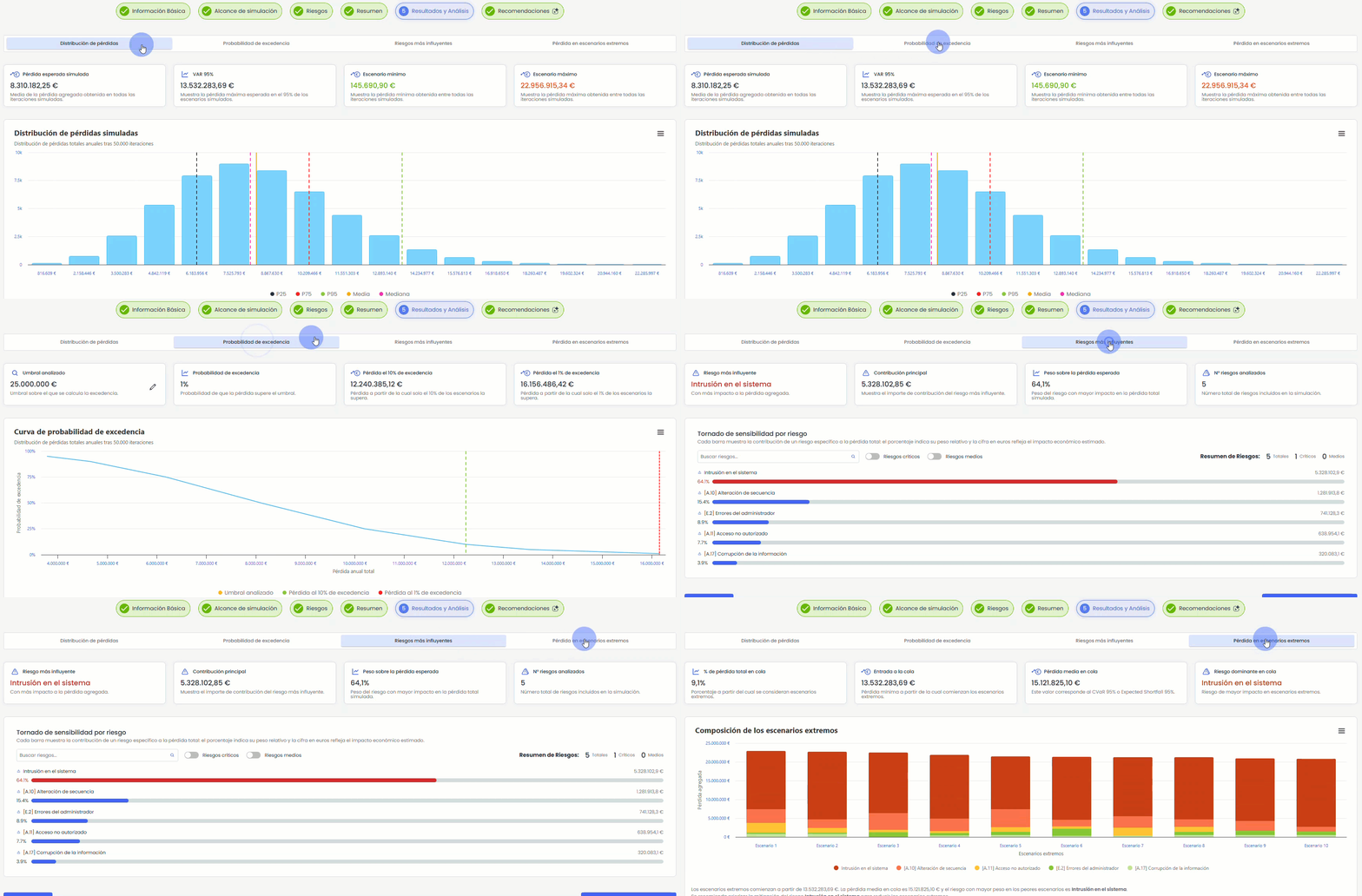
Once the simulation is executed, a results view is incorporated that allows analyzing the scenario from different perspectives:
-
Simulated loss distribution, with indicators such as expected loss, VaR 95%, minimum scenario, and maximum scenario.
-
Exceedance probability, which allows defining an analysis threshold and knowing the probability that the simulated loss exceeds it.
-
Most influential risks, with a tornado sensitivity analysis showing each risk's contribution to the total expected loss.
-
Loss in extreme scenarios, which allows analyzing the composition of the worst scenarios, tail entry, average tail loss, and dominant risk in higher-impact scenarios.
These visualizations facilitate the quantitative analysis of risk exposure, identifying both expected loss and the most severe scenarios.
Recommendations and What-if simulator
The module incorporates the Recommendations view aimed at facilitating decision-making on risk treatment.
From this view, recommended controls for simulated risks are displayed, classified by risk and with information about their type, reduction percentage, estimated effort, implementation timeline, criticality, investment, and expected return. Selected controls can be added to the analysis and associated with the corresponding risk and item.
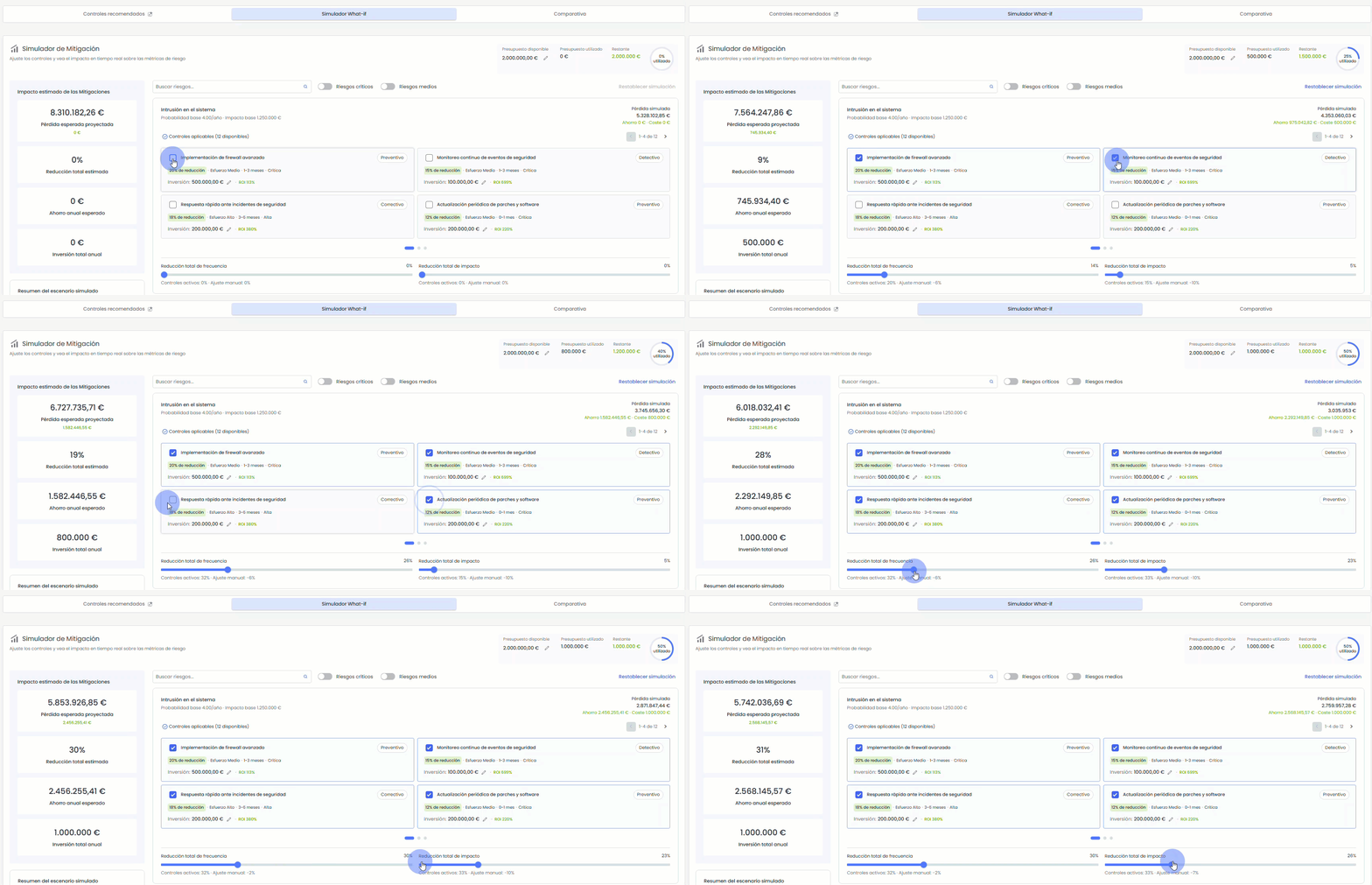
Additionally, a What-if Simulator is included, allowing real-time evaluation of the impact of applying different mitigation measures. It will be possible to select controls, adjust budgets, modify frequency and impact reductions, and automatically visualize the effect on expected loss, annual savings, investment, net benefit, ROI, and payback.
Comparison and executive report
The functionality allows comparing the current scenario against an improved scenario, considering the selected recommendations and the expected impact of mitigation measures.
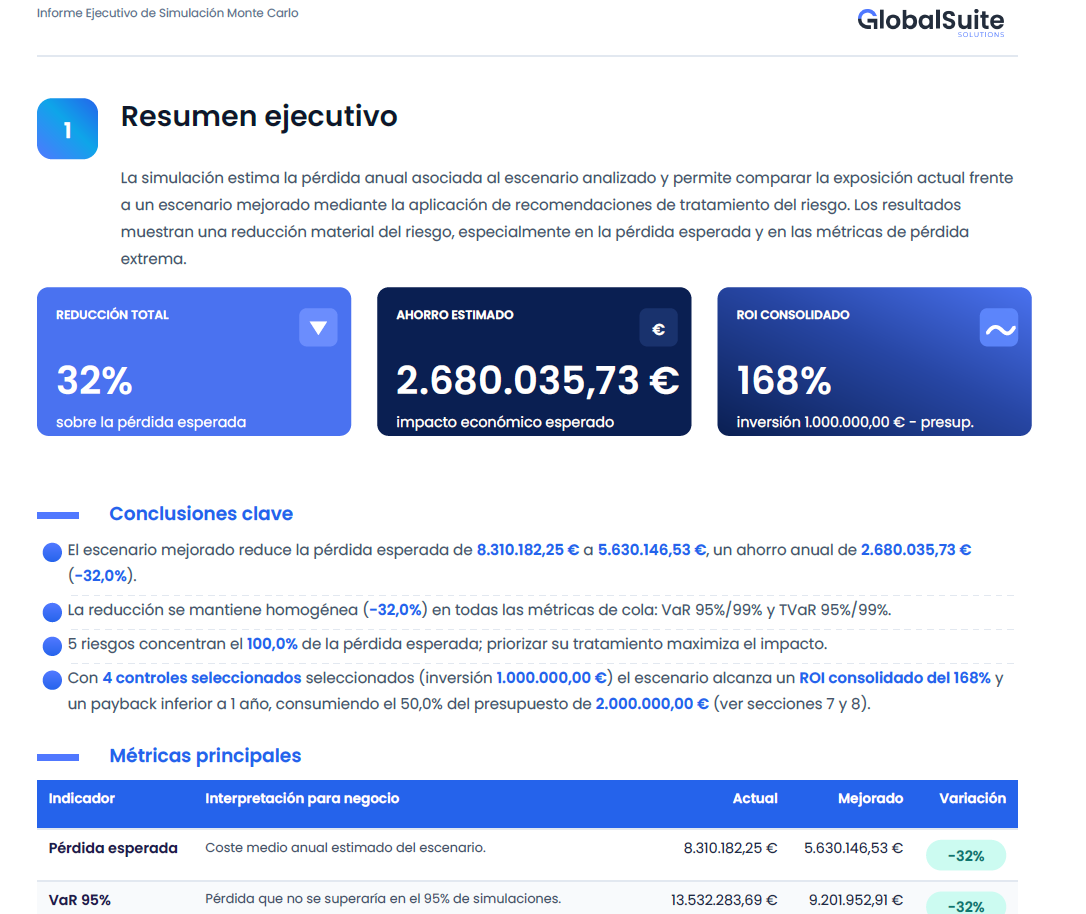
The comparison shows the variation of metrics such as expected loss, VaR 95%, and VaR 99%, as well as the reduction percentage, estimated savings, total investment, maximum implementation timeline, and consolidated ROI.
An Executive Report in PDF is also included, summarizing the simulation results, selected recommendations, main conclusions, and key metrics of the scenario.
Benefits
-
Greater capacity for quantitative analysis of identified risks.
-
Estimation of expected losses and extreme scenarios through Monte Carlo simulations.
-
Quick identification of risks that contribute the most to total economic exposure.
-
Prioritization of mitigation measures based on their impact, cost, expected savings, ROI, and implementation timeline.
-
Clear comparison between the current situation and the improved scenario after applying recommendations.
-
Support for decision-making through charts, KPIs, and a downloadable executive report.
-
Greater traceability and consistency in the evaluation of risk scenarios and in the justification of treatment investments.
For more information about this functionality, you can consult: